English Texts to Practice can help you improve your reading skills as you explore fascinating topics. Learn English through three engaging texts about remarkable monuments from ancient Egypt.
The Pyramids of Egypt

Among the most well-known and enigmatic buildings in the world are the Egyptian pyramids. Built thousands of years ago, they continue to attract millions of visitors every year. These historic structures served as tombs for Egypt’s pharaohs, who were thought to become gods after death. By building grand pyramids, Egyptians hoped to protect their leaders and ensure their safe journey to the afterlife.
Near Cairo, at Giza, are the most popular pyramids. Among them is the Great Pyramid of Khufu, which is the largest of all Egyptian pyramids. Originally standing about 146 meters tall, it remained the tallest man-made structure on Earth for more than 3,800 years. Scientists are still in awe of its size and accuracy, and they continue to research how it was constructed so precisely without the use of contemporary technology.
A sizable labor force was needed to build the pyramids. Recent evidence indicates that the workers were skilled laborers who were compensated with food, shelter, and other benefits rather than being slaves, despite long-held beliefs. They made use of basic implements like ropes, wooden sledges, and copper chisels. To create the shape of the pyramid, massive blocks of limestone were carefully placed after being transported from neighboring quarries.
The pharaoh’s body and valuables were intended to be kept in passageways and chambers inside the pyramids. The ruler was supposed to take these treasures with him into the afterlife. Only a few artifacts remain after numerous pyramids were looted centuries ago.
Despite the passage of thousands of years, the pyramids continue to represent human ingenuity, fortitude, and aspiration. They stand for a society that placed a high value on life after death and had a strong belief in the authority of their gods. In addition to serving as tombs, the pyramids now serve as symbols of the amazing accomplishments of ancient Egyptian civilization.
Rewrite all phrases with the missing words
The Mummies of Ancient Egypt
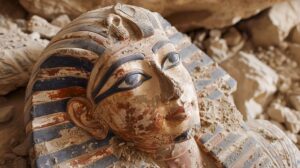
The mummy is among the most fascinating depictions of ancient Egypt. For thousands of years, the Egyptians held the belief that there was life after death. This belief led them to develop an advanced method for preserving the bodies of notable people, especially pharaohs and nobles. This process is now known as mummification.
The goal of mummification was to preserve the body so that it could be recognized by the spirit in the afterlife. Egyptians believed that if the body was destroyed, the soul would perish. As a result, they developed complex techniques that allowed the bodies to be preserved for centuries.
Internal organs were removed as the first stage of mummification and put in special containers known as canopic jars. However, because the heart was thought to be the center of emotion and intelligence, it was typically left inside the body. The body was covered with natron, a natural salt, following the removal of the organs. By completely drying out the body, this salt helped stop decay.
The body was cleaned and oiled to preserve its flexibility after it had dried. The body was then covered in layers of linen bandages by the embalmers. At times, hundreds of meters of cloth were utilized. In order to provide protection in the afterlife, amulets were also positioned between the bandages.
The mummy was then put inside a coffin that had been decorated, frequently with vivid hues and pictures of Egyptian mythological figures and scenes. Important people may even have multiple coffins, one inside the other.
Mummies are now important sources of knowledge for scientists and historians. They aid in our comprehension of traditional dietary habits, medical procedures, and cultural customs. We can learn more about one of the oldest civilizations in history by looking directly into the past through mummies.
Rewrite all phrases with the missing words
Abu Simbel
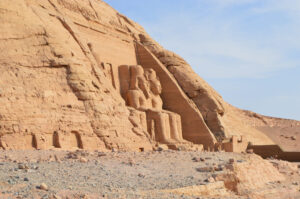
Abu Simbel is one of the most famous archaeological sites in Egypt. It is located in the southern part of the country, near the Sudanese border. During the reign of Pharaoh Ramesses II, two massive rock temples were built at the site over 3,000 years ago. These temples stand out among Egypt’s ancient monuments because they were carved directly into the mountainside.
The larger temple was dedicated to Ramesses II and the gods Amun, Ra-Horakhty, and Ptah. Four massive statues of the pharaoh, each more than 20 meters tall, guard its entrance. Inside are long halls with elaborate carvings that show the king’s relationship with the gods and his military prowess.
The smaller temple was built for Queen Nefertari, the spouse of Ramesses II. It honors the goddess Hathor with beautiful statues and wall paintings.
In the 1960s, both temples were in grave danger. If the Aswan High Dam had been constructed, the entire area would have been submerged. To save Abu Simbel, a multinational team carefully separated the temples into large blocks and moved them to higher ground. Abu Simbel continues to serve as a symbol of both modern preservation efforts and ancient Egyptian engineering.
Rewrite all phrases with the missing words
See here the previous english text Simple Story of Politics
Practice with Videos
Videos are useful because they help you enhance abilities. Watch both subtitled and unsubtitled for better comprehension.
Vocabulary
| Word | Meaning |
|---|---|
| Enigmatic | Mysterious, difficult to understand |
| Contemporary | Modern, belonging to the present time |
| Quarries | Places where stone is taken from the ground |
| Fortitude | Strength and courage in difficult situations |
| Aspiration | A strong desire to achieve something |
| Depictions | Representations or images of something |
| Mummification | Process of preserving a body after death |
| Canopic jars | Containers used to store internal organs in ancient Egypt |
| Natron | Natural salt used to dry out bodies |
| Amulets | Objects believed to provide protection or bring good luck |
| Elaborate | Detailed and complex |
| Prowess | Skill or ability in a particular area |
| Submerged | Covered completely with water |
| Multinational | Involving several countries |
| Preservation | The act of protecting something from damage or decay |